From fall 2026, GoTeacher student usage data show how widely students access AI tools, how much time they spend on them, and what those measures can tell you as you develop guidance.
In fall 2026, roughly three-quarters of students at a Massachusetts public school district and just under half of students at a middle school within the same district accessed at least one site classified as an AI tool under GoTeacher’s metric during school-day reporting hours. Overall, during this time frame, AI-category sites accounted for 4% of all recorded activity time at the high school and 1% at the middle school. As a specific tool categorized by GoTeacher, ChatGPT led the category at both schools.
The data shared describe two different aspects of adoption. The number of students who accessed an AI site shows how broadly these tools had reached students. The time spent on those sites shows how much of their recorded Chromebook activity occurred there. Importantly, an AI tool can reach many students while occupying a small share of their time online.
What do the reports measure?
The overall analysis covers August 31 through November 19, 2026. It draws on GoTeacher reports of website activity on district-issued Chromebooks signed in to the school district’s Google Workspace for Education accounts. It focuses on middle and high schools (grades 5 through 12). The district excluded elementary schools because their reports showed minimal AI-category activity. Enrollment figures come from the district’s October 1, 2026, Student Information Management System submission to the Massachusetts Department of Elementary and Secondary Education.
The district’s filtering settings allowed access to most AI tools during the reporting period. Accessed sites included ChatGPT, Grammarly, Claude, Perplexity, and Microsoft Copilot, among others. The figures describe activity visible to GoTeacher on district-issued devices. Students may also have used AI sites and applications on personal laptops or smartphones, and those interactions fall outside this dataset.
Table 1. AI activity during school day, August 31-November 19, 2026
| Measure | High School | Middle School |
| Enrollment as of October 1 | 650 | 750 |
| Students who accessed at least one AI-category site | 470 (72%) | 375 (50%) |
| AI-category share of total recorded activity time | 4% | 1% |
| Students who accessed ChatGPT (School Hours) | 450 | 250 |
GoTeacher reports activity in hourly increments. The school-day reporting windows were 8:00 a.m. to 2:00 p.m. for the high school and 8:00 a.m. to 3:00 p.m. for the middle school. These windows approximate each school’s schedule. We adjusted actual enrollment counts for anonymity.
ChatGPT accounted for approximately 89% of recorded AI-category time at the high school and 62% at the middle school. Its prominence makes it a useful case for examining how AI access extends across the school day and beyond. The broader landscape also includes AI features embedded in familiar platforms such as Duolingo, Khan Academy, Canva, and AI Mode found within Google Search. GoTeacher may record activity in those applications without identifying when a student used an AI feature. Conversely, some sites classified as AI tools also offer functions that do not involve AI.
ChatGPT activity beyond the high school reporting window
High school students take their district-issued Chromebooks home as part of the school’s one-to-one program. Filtering and activity reporting continue when students use those devices off campus. Across all hours, GoTeacher recorded 765 hours of ChatGPT activity at the high school, with 440 hours falling within the 8:00 a.m. to 2:00 p.m. reporting window. That leaves 325 hours, or about 58% of recorded ChatGPT time, outside the window.
Table 2. High school ChatGPT activity across reporting windows
| Measure | All hours | 8 a.m. to 2 p.m. |
| Students who accessed ChatGPT | 470 | 450 |
| Recorded activity time | 765 hours | 440 hours |
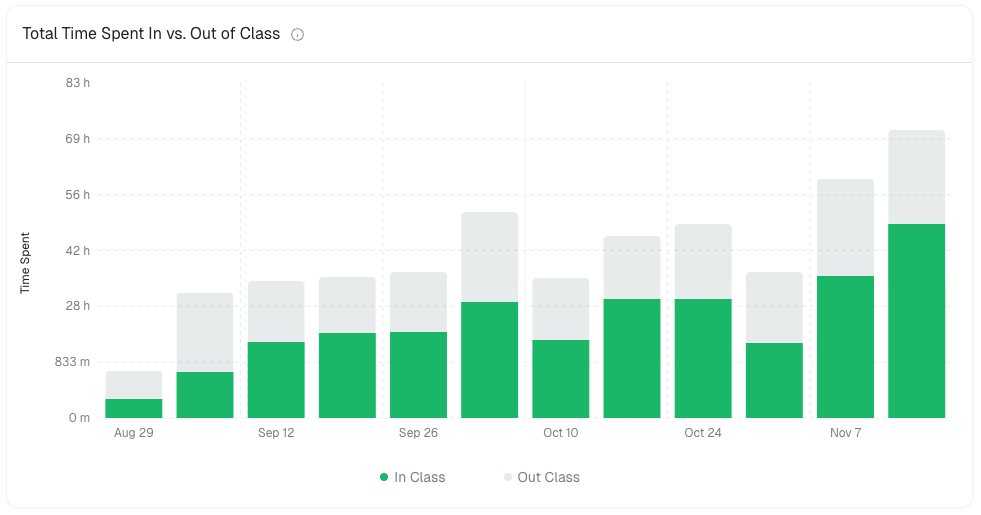
Weekly ChatGPT activity generally increased over the reporting period, although the number of active students and recorded time varied from week to week. GoTeacher’s weekly chart also reports activity under its “in class” and “out of class” designations. Those designations differ from the fixed clock-hour windows in Table 2. Both describe when activity was recorded and leave questions about student location, instructional purpose, and teacher approval open.
Figure 1. Weekly high school ChatGPT activity by GoTeacher’s in-class and out-of-class designations, August 31-November 19, 2026
What can a short AI session tell us?
Among the 450 high school students who accessed ChatGPT during the school day, GoTeacher recorded a median daily usage of seven minutes. A short session can substantially affect the work that follows. A student might ask for a hint and return to a math problem, generate ideas and develop them in a separate Google Doc, or copy a response into an assignment with little revision. Each interaction could produce a similar amount of recorded time while reflecting a very different kind of engagement.
The reports capture online activity within AI categories, in this instance, ChatGPT. Much of the work that flows during and after access may happen in another application or offline. Session counts and page views therefore do not directly tally prompts, assignments, or completed tasks. The same limitation applies to academic integrity and learning outcomes. Those questions require evidence about what students were asked to do, how they used the tool, and what they produced.
What this means for district AI guidance
By mid-November 2026, ChatGPT has already reached hundreds of students in the middle and high schools, and most recorded high school ChatGPT time fell outside the school-day reporting window. That pattern gives the district a reason to address independent work alongside classroom use. Students need clear expectations about when AI can help them practice, brainstorm, or revise, when they should disclose its use, and when an assignment calls for work completed independently.
Teachers and students can help answer the questions the reports leave open. Teachers can describe where AI supports an instructional goal and where it makes student understanding harder to assess. Students can explain when they turn to these tools, what they do with the responses, and where classroom expectations are unclear. Together, those perspectives can help the district develop guidance grounded in how students encounter AI during and beyond the school day.
—