The Department of Technology & Digital Learning advanced several initiatives to modernize instructional technology, strengthen digital equity, improve student focus through intentional policy, and safeguard the digital environment for staff and students. All of these efforts work together to enhance teaching and learning, ensure equitable access to technology tools, and establish the conditions necessary for a high-quality education.
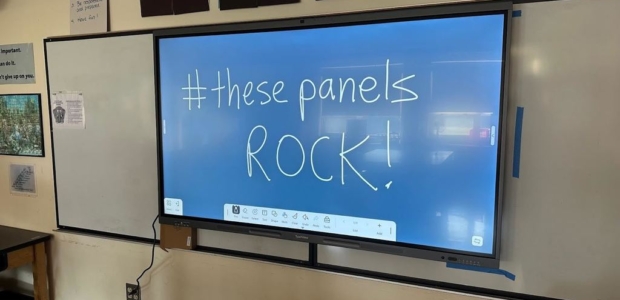
We are completing a multi-year modernization of classroom technology, replacing outdated projectors with interactive teaching panels. Following earlier installations at the elementary level, our most recent phases deployed units at Middle School North, the Marion Stoddart Building, and the Boutwell Early Childhood Center. With more than 150 interactive panels available in academic locations, the district has significantly expanded its capacity to support universal design for learning principles and provide faculty with modern instructional tools.
In addition to keeping instructional classroom equipment up to date, we also distributed approximately 50 touchscreen laptops to educators. The continued support of our life-cycle replacement plan promotes the best possible environment for staff and students to be successful. With new equipment, our department provided extensive professional learning, including a paid summer workshop that prepared a cohort of TouchView Ambassadors to support their colleagues, as well as several professional development opportunities throughout the year. As always, our Help Desk ticketing system remains suited to support staff around their busy academic schedules.
As we discuss screen time with staff and the community at large alongside off-task behaviors, we continue to support balanced technology access strategies. At the Groton-Dunstable Regional High School, the 1:1 Chromebook program is now in its first full year, providing all students with a district-issued Chromebook that supports equitable access to digital resources and strengthens proficiency with Google Workspace tools. In conjunction with the 1:1 improvements, the high school is in its second year of a no-smartphone policy during the academic day. This initiative is designed to reduce distractions, promote stronger in-person engagement, and reinforce a learning environment focused on academics and well-being. It also aligns with a growing national conversation about the role of smartphones in schools and positions the district ahead of the statewide requirement that will take effect in 2026. Consistent application of our “off and away” policy remains a critical factor in sustaining its benefits.
Professional learning remains a core priority, particularly in the area of artificial intelligence. Many of our outstanding GD educators completed the Massachusetts Department of Elementary and Secondary Education’s AI Literacy training and earned professional development points toward their license renewal. The AI training is structured to build a foundational understanding, address ethical considerations, and help educators assess the advantages and limitations of AI in educational contexts. The Department of Technology & Digital Learning team has supplemented this work with introductory sessions on emerging AI tools and software, including Google’s AI-supported note-taking and research tool Notebook LM, among others. The emphasis is on helping staff make informed, responsible decisions that ensure the best possible academic environment.
As we all know, security does not take vacations. Our cybersecurity posture and data protection remain essential. The district employs a multi-layered security posture for advanced email threat detection and comprehensive endpoint protection, enabling the identification and remediation of potential risks. Device and cloud-based filtering systems contribute to a safe learning environment, supported by standard best practices such as regular software patching, Multi-Factor Authentication, and strong password management. As the district prepares for upcoming changes and advancements in data security, we will continue to adopt and integrate educational software and technology resources through the Student Data Privacy Consortium (SDPC) to reinforce our data governance and privacy practices.